
Psychology & Behaviour
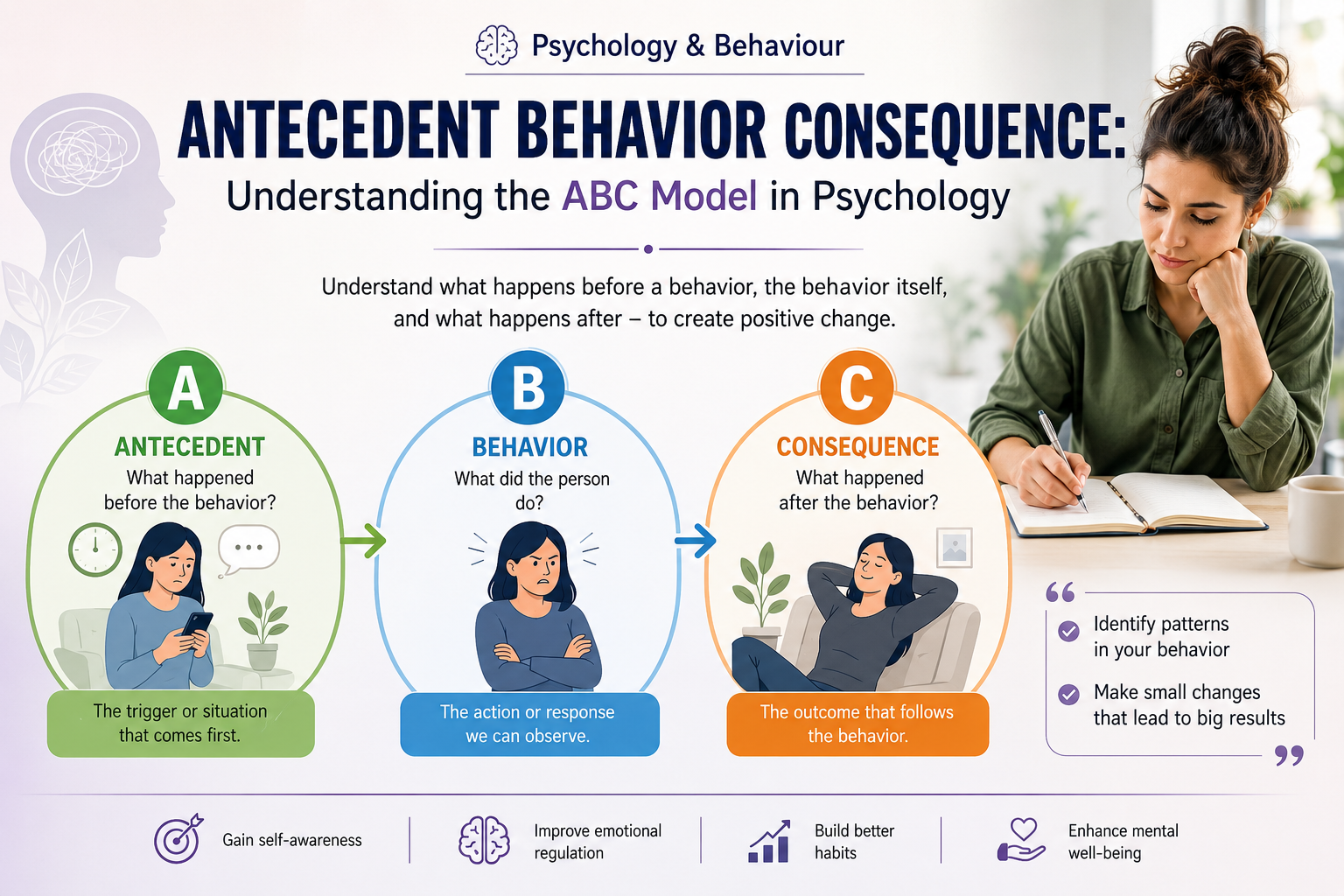
Antecedent Behavior Consequence: Understanding the ABC Model in Psychology
Have you ever promised yourself you would react differently next time, only to find yourself repeating exactly the same behaviour?
Maybe you avoid an uncomfortable conversation, procrastinate when a task feels overwhelming, repeatedly check your phone when you're anxious, or lose your temper in a situation that seems to trigger the same reaction every time.
Psychology often looks beyond the behaviour itself and asks a more useful question: what happened before it, what exactly did the person do, and what happened immediately afterwards?
This is the idea behind the antecedent behavior consequence model, commonly called the ABC model of behaviour.
In simple terms:
Antecedent → Behavior → Consequence
Looking at these three parts together can help reveal patterns that are difficult to notice when we focus only on the behaviour.
What Is Antecedent Behavior Consequence?
Antecedent behavior consequence is a simple framework used to examine behaviour in context.
Instead of labelling a behaviour as "good," "bad," "irrational," "lazy," or "difficult," the ABC model breaks an event into three observable parts:
- A — Antecedent: what happened immediately before the behaviour.
- B — Behavior: what the person actually did.
- C — Consequence: what happened immediately after the behaviour.
The purpose is not simply to document what went wrong. It is to understand the circumstances in which a behaviour appears and what may be helping that pattern continue.
This way of thinking is particularly common in behavioural psychology, applied behaviour analysis and functional behaviour assessment, although similar pattern-based thinking can also appear in psychotherapy.
Simple definition: The ABC model examines what happens before a behaviour, the behaviour itself, and what happens afterwards.
A: What Is an Antecedent?
An antecedent is something that happens before a behaviour.
People sometimes use the word "trigger" instead, although an antecedent does not necessarily force someone to behave in a particular way. It simply helps us understand the conditions surrounding the behaviour.
Antecedents can include:
- A request from another person
- A difficult task
- An argument
- A notification on your phone
- Being criticised
- Feeling embarrassed
- Entering a crowded room
- Being asked to speak in a meeting
- Receiving no response to a message
- Having to begin studying
- A change in routine
- A particular person entering the room
Internal experiences may matter too. Anxiety, fatigue, hunger, memories, physical discomfort and thoughts can all influence how someone responds to a situation.
For example, imagine that you send an important WhatsApp message and the other person does not respond for several hours.
The unanswered message may become part of the antecedent situation. You might then begin thinking: "Did I say something wrong?"
Understanding these patterns can be particularly useful when anxiety and overthinking seem to appear repeatedly in similar situations.
B: What Counts as Behavior?
The behavior is the action being examined.
Ideally, it should be described specifically instead of using vague interpretations.
For example, instead of writing:
"I became difficult."
You might write:
"I raised my voice, ended the conversation and went into another room."
Instead of:
"I was lazy."
You might record:
"I opened Instagram instead of starting the assignment and scrolled for 35 minutes."
The second descriptions are more useful because they tell us what actually happened.
This matters because words such as lazy, dramatic, attention-seeking or unmotivated are interpretations. They do not tell us much about the behaviour itself.
A more neutral description makes it easier to look at the situation without immediately blaming yourself or someone else.
C: What Is a Consequence?
In everyday language, "consequence" often sounds like punishment.
In the antecedent behavior consequence model, however, consequence simply means:
What happened after the behaviour?
A consequence could be:
- Someone gives you attention
- A difficult task disappears temporarily
- You feel immediate relief
- An argument ends
- Someone reassures you
- You receive praise
- You avoid an uncomfortable situation
- You gain access to something enjoyable
- You feel guilty afterwards
- Another person becomes angry
What makes consequences particularly interesting is that an immediate consequence may unintentionally make a behaviour more likely to happen again.
Consider avoidance
Imagine that you feel anxious before giving a presentation.
You cancel the presentation.
Your anxiety immediately decreases.
That relief can make cancellation or avoidance feel even more attractive next time.
In other words, a behaviour can create short-term relief while creating a longer-term problem.
This type of avoidance cycle is common in anxiety and is one reason psychological therapy often works on changing both thoughts and behaviours. You can learn more in our guide to Cognitive Behavioural Therapy (CBT).
Antecedent Behavior Consequence Examples
The ABC model becomes much easier to understand when we look at ordinary situations.
Example 1: Social anxiety
| Antecedent | Behavior | Consequence |
|---|---|---|
| You are invited to a social event. | You say you are busy and stay home. | Your anxiety drops immediately. |
The important detail here is not simply that the person avoids the event. Avoidance creates relief.
That immediate relief may help explain why avoiding similar situations becomes easier and more automatic over time.
Example 2: Procrastination
| Antecedent | Behavior | Consequence |
|---|---|---|
| You open a difficult work project. | You start watching videos instead. | You temporarily stop feeling overwhelmed. |
From the outside, this may look like poor discipline.
An ABC analysis reveals something more useful: procrastination may be providing temporary escape from discomfort.
Example 3: Reassurance seeking
| Antecedent | Behavior | Consequence |
|---|---|---|
| Your partner replies differently than usual. | You repeatedly ask whether something is wrong. | Your partner reassures you and your anxiety briefly reduces. |
Again, the reassurance may work very well in the short term.
The difficulty is that repeatedly relying on reassurance can sometimes strengthen the feeling that anxiety cannot be tolerated without checking.
Example 4: Exam stress
| Antecedent | Behavior | Consequence |
|---|---|---|
| You look at a large syllabus before an exam. | You close the book and scroll through your phone. | You feel temporarily less stressed. |
Students facing JEE, NEET, UPSC and other competitive examinations may experience cycles like this when stress becomes overwhelming. Our guide to mental health during competitive exams explores this pressure in more detail.
Example 5: Anger during family conflict
| Antecedent | Behavior | Consequence |
|---|---|---|
| A family member criticises a decision you made. | You shout and leave the room. | The conversation immediately stops. |
The shouting may have many contributing causes, but one thing becomes visible: it successfully ends an uncomfortable interaction.
That information can give a therapist and client something concrete to explore.
Why the ABC Model Can Be So Useful
When people struggle with repeated behaviours, they often focus entirely on the middle of the chain.
"Why do I keep doing this?"
The ABC model widens the picture.
It encourages questions such as:
- What situations usually come before this?
- Who tends to be present?
- What am I feeling before it happens?
- What do I actually do?
- What happens immediately afterwards?
- Do I gain something?
- Do I escape something?
- Does my discomfort reduce?
- Does another person respond differently?
- Does the same pattern happen repeatedly?
These questions can transform a vague problem into something that can be examined more clearly.
Instead of:
"I have no self-control."
You may begin noticing:
"I tend to do this when I feel criticised, and walking away immediately reduces the discomfort."
That is a much more workable starting point for change.
Is Antecedent Behavior Consequence Related to Therapy?
Yes, it can be.
Antecedent–Behavior–Consequence analysis comes primarily from behavioural psychology and behaviour analysis, but examining triggers, actions and maintaining consequences can also form part of a broader psychological formulation.
A therapist might explore questions such as:
- When does the behaviour usually occur?
- What emotions or situations tend to come before it?
- What short-term purpose does the behaviour serve?
- Does it reduce fear?
- Does it create distance from another person?
- Does it help you escape something uncomfortable?
- What are its longer-term costs?
The goal is generally not to judge the behaviour.
In fact, behaviours that seem unhelpful today often make more sense when we understand what they are doing for the person in the moment.
Avoidance may reduce fear. Withdrawal may prevent conflict. Constant checking may temporarily reduce uncertainty. Procrastination may provide relief from overwhelm.
Once the pattern becomes clearer, therapy can focus on developing different responses that meet the same underlying need without creating as many long-term problems.
If you are wondering what working with a psychologist actually involves, read how therapy helps and what the research says .
Antecedent Behavior Consequence and Anxiety
Anxiety provides a particularly clear example of why looking at consequences matters.
Consider this cycle:
- You feel anxious about something.
- You avoid it.
- You immediately feel better.
- Your brain learns that avoidance produces relief.
- The next similar situation feels even harder to approach.
The immediate consequence is positive from the person's perspective: anxiety decreases.
But over time, repeated avoidance can narrow someone's life.
They may begin avoiding meetings, social events, travelling, difficult conversations, phone calls, presentations or situations involving uncertainty.
A psychologist can help identify these cycles and work gradually on healthier responses.
Therapy for anxiety may involve approaches such as CBT, gradual exposure, mindfulness-based strategies, emotional regulation and reducing safety behaviours, depending on the person's needs.
Read more about anxiety and overthinking support.
Antecedent Behavior Consequence and Procrastination
Procrastination is another behaviour that is easy to misunderstand when we look only at the action itself.
Imagine someone repeatedly postpones an assignment.
At first glance:
Behavior: They do not start their work.
ABC analysis asks for more information.
Antecedent: They look at the assignment and think it is too difficult.
Behavior: They open YouTube and watch videos.
Consequence: Their anxiety decreases for the next hour.
Suddenly the procrastination makes more sense.
It is not necessarily that the person does not care about their work. The behaviour may be helping them escape an uncomfortable emotional state.
Unfortunately, the relief is temporary. The unfinished work remains, deadlines move closer and anxiety often becomes stronger later.
Recognising this loop creates more options. The goal becomes not simply "force yourself to work," but learning how to respond differently when discomfort appears.
Using the ABC Model to Understand Children's Behaviour
Parents and educators may also come across the antecedent behavior consequence chart when trying to understand repeated behaviours in children.
For example:
| Antecedent | Behavior | Consequence |
|---|---|---|
| A parent asks a child to turn off a game and begin homework. | The child screams and throws the notebook. | Homework is delayed for 20 minutes while everyone calms down. |
It can be tempting to focus exclusively on the screaming.
But the ABC sequence raises additional questions:
- Does this happen mainly during transitions?
- Does it happen specifically with difficult schoolwork?
- Was the child already tired or overwhelmed?
- Does the behaviour reliably delay the task?
- Would a clearer transition warning help?
- Does the child need another way to communicate frustration?
The purpose is not to blame the child or the parent. It is to understand the pattern more accurately.
Behaviour can communicate distress, frustration, sensory overload, confusion, fear, a need for attention, difficulty transitioning or many other things.
Parents interested in supporting emotional communication may also find our guide to talking to children about mental health helpful.
For persistent, severe or potentially dangerous behaviour, a qualified psychologist or appropriately trained behavioural professional should assess the situation rather than relying on a self-created ABC chart alone.
How to Create an Antecedent Behavior Consequence Chart
An ABC behavior chart can be surprisingly simple.
You can create three main columns:
| Antecedent | Behavior | Consequence |
|---|---|---|
| What happened immediately before? | What exactly happened? | What happened immediately afterwards? |
You may also want to record:
- Date and time
- Location
- Who was present
- Emotional state
- Physical state such as fatigue or hunger
- Duration of the behaviour
- Intensity
- What happened later
Example ABC diary
| Situation | Antecedent | Behavior | Consequence |
|---|---|---|---|
| Work meeting | Manager asks for an unexpected update | I say very little and turn my camera off | I feel immediate relief but worry about it afterwards |
| Relationship | Partner takes several hours to reply | I send four follow-up messages | I receive reassurance and briefly feel calmer |
| Studying | I open a difficult chapter | I start scrolling social media | I feel less overwhelmed temporarily |
Do not analyse every entry immediately
One event does not necessarily reveal a pattern.
ABC tracking is often more useful when several examples are recorded and compared.
You might eventually notice:
- The same antecedent appears repeatedly
- The behaviour happens at a particular time
- Certain emotions are usually present beforehand
- The behaviour consistently creates relief
- The behaviour reliably ends a demand
- Another person's response repeatedly follows it
Those observations can provide useful information to discuss with a therapist.
How Can You Change an ABC Behaviour Pattern?
Identifying the ABC sequence is only the first step.
Once a pattern becomes visible, there may be several points where change is possible.
1. Change the antecedent when possible
Sometimes the environment can be adjusted before the behaviour occurs.
For example:
- Breaking a large task into smaller steps
- Creating clearer routines
- Reducing unnecessary distractions
- Preparing for difficult conversations
- Giving advance warning before transitions
2. Develop an alternative behaviour
Rather than only trying to suppress an unwanted behaviour, it can be more effective to identify another response.
Someone who withdraws whenever conflict appears might practise saying:
"I want to continue this conversation, but I need ten minutes to calm down first."
Someone who procrastinates when overwhelmed might practise working for only five minutes before deciding whether to continue.
3. Examine the consequence
Ask what the behaviour provides in the short term.
Is it:
- Relief?
- Escape?
- Reassurance?
- Attention?
- Control?
- Comfort?
Once that need is clearer, healthier ways of meeting it can sometimes be developed.
4. Build tolerance for uncomfortable emotions
Some patterns persist because the alternative requires temporarily tolerating anxiety, frustration, uncertainty, embarrassment or boredom.
Therapy can help people gradually build that capacity instead of expecting an immediate personality transformation.
Emotional flexibility and recovery are skills that can develop over time. Read more about building emotional resilience .
ABC Behavior Model vs the ABC Model in CBT: Are They the Same?
This is an important distinction because searching for "ABC model psychology" can produce two different explanations.
Antecedent–Behavior–Consequence
The model discussed throughout this article is:
Antecedent → Behavior → Consequence
It is closely associated with behavioural analysis and functional assessment.
Activating Event–Belief–Consequence
Another ABC framework, particularly associated with Rational Emotive Behaviour Therapy and sometimes discussed alongside cognitive therapy, uses:
Activating Event → Belief → Emotional/Behavioural Consequence
For example:
- Activating event: A friend does not reply to your message.
- Belief: "They must be angry with me."
- Consequence: You become anxious and repeatedly check your phone.
These frameworks overlap in their interest in understanding patterns, but they are not identical.
CBT more broadly examines relationships between situations, thoughts, emotions and behaviours.
If you want a deeper introduction, see CBT explained: how cognitive behavioural therapy works .
Can ABC Analysis Help With Mental Health?
An ABC chart is not a diagnosis and it is not a complete therapy by itself.
However, understanding behaviour in context can contribute to therapy when someone is experiencing patterns such as:
- Anxiety and avoidance
- Procrastination
- Anger and conflict
- Reassurance seeking
- Stress-related habits
- Withdrawal
- Compulsive behaviours
- Difficulty managing emotional reactions
For example, compulsions may temporarily reduce anxiety, which can help maintain a repetitive cycle. If you'd like to understand that process in a more condition-specific context, read what OCD really looks like beyond common stereotypes .
Behavioural withdrawal can also become relevant in depression, where low mood, reduced activity and loss of positive experiences may interact. Our guide to commonly missed signs of depression explains how depression can affect behaviour as well as mood.
Limitations of the Antecedent Behavior Consequence Model
The simplicity of the ABC model is one of its strengths, but it can also create problems when the framework is treated as more certain than it really is.
An ABC chart shows patterns, not necessarily causes
If something regularly happens before or after a behaviour, that does not automatically prove that it causes the behaviour.
Behaviour can be influenced by many interacting factors.
Human behaviour is rarely perfectly linear
A consequence from one situation can become an antecedent for the next. Emotions, thoughts, relationships and past experiences can interact in ways that a three-column table cannot fully capture.
The same behaviour can serve different purposes
Two people may perform the same behaviour for entirely different reasons.
Even the same person's behaviour may serve different functions in different situations.
Self-observation can be biased
When we are emotionally involved in an event, it can be difficult to describe what happened objectively.
This is one reason professional assessment can be valuable when a pattern is complicated or significantly affecting someone's life.
When Should You Discuss a Behaviour Pattern With a Therapist?
You do not have to wait for a behaviour to become extreme before discussing it with someone.
Professional support may be worth considering when a repeated pattern:
- Is affecting your relationships
- Interferes with work or studies
- Causes significant anxiety or distress
- Feels difficult to control
- Is becoming more frequent
- Leads you to avoid important parts of life
- Continues despite repeated attempts to change it
Therapy is not simply about being told to stop a behaviour.
A psychologist can help you understand the wider pattern — including thoughts, emotions, situations, relationships and the short-term function the behaviour may be serving.
If you've never spoken with a therapist before, our guide to what happens during your first therapy session can make the process feel more predictable.
And if you're unsure who to speak with, read our complete guide to finding the right therapist in India .
The Bigger Idea: Behaviour Usually Makes More Sense in Context
One of the most useful lessons from the antecedent behavior consequence model is surprisingly simple:
Behaviour rarely happens in isolation.
What looks like procrastination may be connected to overwhelm. What looks like avoidance may provide relief from anxiety. What looks like constant checking may reduce uncertainty for a few minutes. What looks like anger may quickly end an uncomfortable conversation.
Understanding that context does not mean every behaviour is helpful or acceptable.
It means that meaningful change often begins with understanding the pattern instead of simply criticising the person performing it.
By asking what happened before, what did I do, and what happened afterwards?, you can begin noticing patterns that were previously happening automatically.
And once a pattern becomes visible, there are usually more opportunities to change it.
Want Help Understanding a Pattern You Keep Repeating?
Sometimes we can recognise our habits but still struggle to understand why they keep happening.
Working with a psychologist can help you explore the thoughts, emotions, triggers and behavioural patterns involved, then develop responses that fit your actual situation rather than relying on generic advice.
TherapyHelps connects you with qualified mental health professionals for private online support based on your needs, preferences and concerns.
Still deciding whether professional support is right for you? Read signs you may benefit from therapy even when nothing feels seriously wrong .
Frequently Asked Questions About Antecedent Behavior Consequence
What does antecedent behavior consequence mean?
Antecedent behavior consequence, or ABC, is a framework for examining behaviour. The antecedent is what happens before the behaviour, the behavior is the action itself, and the consequence is what happens immediately afterwards.
What is an example of antecedent behavior consequence?
Imagine a student sees a difficult assignment (antecedent), starts scrolling through social media instead of working (behavior), and feels temporarily less anxious (consequence). Recording this pattern may help explain why procrastination continues even when the student genuinely wants to complete the work.
What is the ABC model in psychology?
The term ABC model can refer to more than one psychological framework. In behavioural analysis, ABC usually means Antecedent–Behavior–Consequence. In REBT and some cognitive therapy discussions, ABC may instead refer to Activating Event–Belief–Consequence.
What is an antecedent in psychology?
An antecedent is an event, situation or condition that occurs before a behaviour. It may include a request, social interaction, environmental change, difficult task or other circumstance associated with the behaviour.
Does consequence mean punishment?
No. In the ABC behavior model, consequence simply means what happens after a behaviour. It could involve attention, relief, reassurance, escape from a task, praise, discomfort or many other outcomes.
What is an ABC behavior chart?
An ABC behavior chart is a simple recording tool with separate sections for the antecedent, behaviour and consequence. It can be used to record repeated events and look for patterns over time.
Can I use an ABC chart on myself?
Yes. An ABC diary can be a useful self-reflection tool for everyday patterns such as avoidance, procrastination or reassurance seeking. However, it should not be used as a substitute for professional assessment when behaviours are severe, dangerous or significantly affecting daily functioning.
Is the ABC model part of CBT?
Antecedent–Behavior–Consequence analysis comes primarily from behavioural approaches. CBT also examines behavioural patterns, but CBT commonly looks more broadly at interactions between situations, thoughts, emotions and behaviours. A different ABC framework — Activating Event, Belief and Consequence — is also associated with REBT and cognitive approaches.
How does ABC analysis help change behaviour?
ABC analysis can help identify situations that commonly precede a behaviour and outcomes that may help maintain it. Once these patterns are better understood, a person or professional can consider changes to the environment, alternative behaviours or different responses to the consequences.
Sources & Further Reading
This article was informed by established literature on behavioural assessment, functional analysis and psychological treatment, including:
- Vanderbilt University IRIS Center — Functional Behavior Assessment and descriptive ABC assessment guidance.
- Research literature on antecedent–behavior–consequence functional analysis and the three-term contingency.
- Clinical literature describing behavioural ABC analysis alongside cognitive ABC frameworks in psychological treatment.
- Peer-reviewed research examining functional analysis of avoidance and procrastination.