
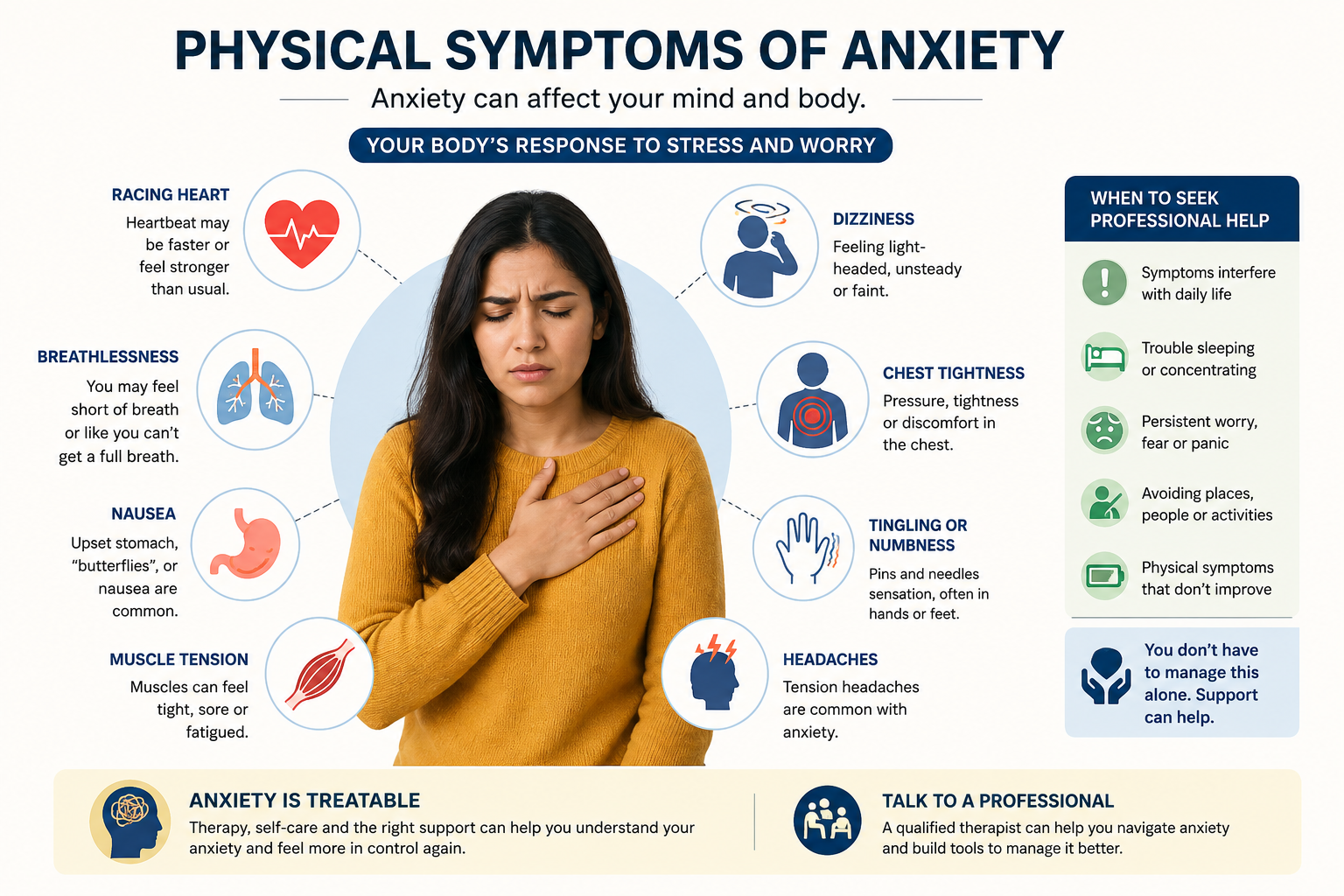
Physical Symptoms of Anxiety: Chest Tightness, Dizziness, Nausea and More
Anxiety does not always feel like worry. Sometimes it shows up in your body first: a racing heart, tight chest, unsettled stomach, dizziness, shaking, or the feeling that you cannot take a satisfying breath.
These can all be physical symptoms of anxiety. Anxiety affects systems throughout the body, which means symptoms may appear in your heart, breathing, digestion, muscles, sleep, and energy levels.
Sometimes these physical sensations can even appear before you consciously realise that you are feeling anxious.
What Are the Physical Symptoms of Anxiety?
Common physical anxiety symptoms can include:
- Racing, pounding, or noticeably strong heartbeat
- Chest tightness or chest discomfort
- Shortness of breath
- Feeling unable to take a deep breath
- Dizziness or light-headedness
- Nausea or an unsettled stomach
- Stomach cramps or digestive changes
- Sweating
- Trembling or shaking
- Muscle tension
- Headaches
- Tingling or numbness
- Feeling hot or experiencing chills
- Dry mouth
- Fatigue
- Difficulty sleeping
- Physical restlessness
The exact combination differs from person to person. One person may mainly experience stomach problems, while another may notice their heartbeat, breathing, headaches, or muscle tension.
Why Does Anxiety Cause Physical Symptoms?
Anxiety is not happening only in your thoughts. Your brain and body continuously communicate with each other.
When your brain believes there may be danger, your body's stress response becomes more active. This response is useful when there is an actual threat because it prepares you to react quickly.
During this response:
- Your heart may beat faster.
- Your breathing may become quicker or shallower.
- Your muscles may tense.
- Your attention may become more focused on potential threats.
- Your digestive system may temporarily change.
The same response can happen when the threat is psychological rather than physical.
For example, your body may respond strongly when you are:
- About to give a presentation
- Preparing for an important exam
- Going into a difficult meeting
- Experiencing relationship stress
- Worried about finances
- Entering an uncomfortable social situation
- Anticipating that something might go wrong
There may be no immediate physical danger, but your nervous system can still respond as though you need to protect yourself.
1. Chest Tightness and Chest Pain
Chest sensations are among the most frightening physical symptoms of anxiety.
You may experience:
- Tightness across the chest
- Pressure or heaviness
- Brief or recurring discomfort
- Difficulty taking a full breath
- Increased awareness of your heartbeat
Anxiety can contribute to these sensations in several ways. Your chest and shoulder muscles may become tense, your breathing may become faster or shallower, and your heart rate may increase.
This can sometimes create a cycle:
- You notice discomfort in your chest.
- You think something may be seriously wrong.
- Your fear increases.
- Your stress response becomes stronger.
- Your heartbeat increases and your chest feels tighter.
- The stronger sensations increase your fear even further.
This type of feedback loop can occur during anxiety and panic attacks.
2. Racing Heart and Heart Palpitations
You may suddenly become extremely aware of your heartbeat.
It might feel as though your heart is:
- Beating very quickly
- Pounding
- Fluttering
- Skipping beats
- Beating unusually hard
The body's stress response can increase cardiovascular activity. The sensation itself may then become another source of anxiety.
You notice your heartbeat, start monitoring it, become more anxious, and then notice your heart beating even faster.
New or persistent palpitations should still be discussed with a healthcare professional, particularly if they occur frequently, happen during exercise, lead to fainting, or are accompanied by significant chest discomfort.
3. Anxiety and Dizziness
Dizziness and light-headedness are also commonly reported anxiety symptoms in the body.
When you become anxious, your breathing pattern can change without you noticing. You may start breathing more quickly, more shallowly, or primarily through your upper chest.
This can contribute to sensations such as:
- Dizziness
- Light-headedness
- Tingling
- Feeling unsteady
- Feeling detached or unreal
A similar feedback loop can happen:
Dizziness → fear that something is wrong → more anxiety → more dizziness.
Dizziness that is new, persistent, severe, or associated with fainting, weakness, hearing changes, severe headache, or neurological symptoms should be medically evaluated.
4. Anxiety, Nausea and Stomach Problems
Your brain and digestive system are closely connected.
This is one reason anxiety can produce noticeable digestive symptoms, including:
- Nausea
- A "butterflies" feeling
- Stomach cramps
- Indigestion
- Bloating
- Reduced appetite
- Diarrhoea
- Constipation
- An urgent need to use the bathroom
Some people notice these symptoms mainly before stressful situations such as meetings, interviews, exams, travel, or social events.
Eventually, a person may start avoiding situations because they are worried about feeling sick. While avoidance can reduce anxiety temporarily, repeated avoidance may strengthen anxiety over time.
5. Shortness of Breath and Feeling Unable to Take a Deep Breath
Anxiety can produce the frightening sensation that you cannot get enough air.
You might find yourself:
- Taking repeated deep breaths
- Yawning frequently
- Sighing repeatedly
- Monitoring your breathing
- Feeling pressure around your chest
- Feeling as though a breath never feels complete
Anxiety can change your breathing pattern and make you more aware of sensations that normally happen automatically.
Significant or unexplained breathing difficulties should be medically assessed, because shortness of breath can also have causes unrelated to anxiety.
6. Shaking and Trembling
Your hands, legs, voice, or entire body may shake when you become anxious.
This may be especially noticeable during:
- Panic attacks
- Public speaking
- Social situations
- Confrontations
- Job interviews
- Exams
- High-pressure situations
Your body's stress response prepares your muscles for action, which can contribute to trembling or shakiness.
The shaking itself may then cause additional anxiety if you are worried that other people will notice it.
7. Muscle Tension and Body Pain
Anxiety can cause you to unconsciously tense your muscles for long periods of time.
Common areas include:
- Jaw
- Neck
- Shoulders
- Upper back
- Lower back
- Forehead
Over time, this tension may contribute to:
- Headaches
- Jaw discomfort
- Neck pain
- Shoulder pain
- General body aches
You may become so accustomed to holding tension that you only notice it when you deliberately try to relax your muscles.
8. Sweating, Hot Flashes and Chills
Sweating is another common physical response to anxiety.
You may notice sweating around your:
- Palms
- Face
- Underarms
- Back
Some people also experience sudden warmth, flushing, or chills.
In social situations, noticing yourself sweating can itself create more anxiety, especially if you begin worrying that other people can see it.
9. Tingling or Numbness
Anxiety and panic may sometimes produce tingling sensations in areas such as the:
- Fingers
- Hands
- Feet
- Face
- Lips
Changes in breathing during periods of intense anxiety can contribute to these sensations.
Sudden numbness or weakness, particularly when limited to one side of the body or accompanied by speech, vision, or coordination changes, should be treated as a medical concern rather than automatically attributed to anxiety.
10. Headaches
Anxiety can contribute to headaches through factors such as:
- Muscle tension
- Poor sleep
- Jaw clenching
- Stress
- Changes in routine
- Long periods of concentration
For some people, recurring headaches are one of the first signs that their stress or anxiety levels are increasing.
Can You Have Physical Symptoms of Anxiety Without Feeling Anxious?
Yes. It is possible to experience physical symptoms of anxiety without feeling anxious at first.
Your body's stress response can become active before you fully recognise the thoughts, pressures, or situations affecting you.
You might think:
"I'm fine. I don't feel worried."
But your body may be showing signs such as:
- Tight shoulders
- A faster heartbeat
- An unsettled stomach
- Shallow breathing
- Restlessness
- Jaw clenching
Sometimes noticing these physical symptoms is what helps you realise that your stress level has increased.
However, unexplained physical symptoms should not automatically be assumed to be anxiety. Medical causes may need to be considered, especially if symptoms are new, severe, persistent, or changing.
How Physical Anxiety Symptoms Can Create a Feedback Loop
One reason physical anxiety can become particularly uncomfortable is that body sensations and anxious thoughts can reinforce one another.
- You notice your heart beating faster.
- You think, "Why is my heart doing that?"
- You worry that something dangerous is happening.
- Your anxiety increases.
- Your heart begins beating even faster.
- The stronger sensation appears to confirm your fear.
This type of cycle is particularly common with panic.
Therapy can help you learn to separate the physical sensation from the catastrophic interpretation you may automatically attach to it.
For example:
Sensation: "My heart is beating quickly."
Automatic thought: "Something terrible is about to happen."
More balanced observation: "My heart rate has increased. I have experienced this during anxiety before. I can observe what is happening without immediately assuming the worst."
Physical Anxiety Symptoms vs a Panic Attack
Experiencing physical anxiety does not necessarily mean you are having a panic attack.
Anxiety symptoms may build gradually and remain present for longer periods. A panic attack usually involves a more sudden surge of intense fear or discomfort.
During a panic attack, someone may experience:
- Racing heartbeat
- Chest discomfort
- Difficulty breathing
- Dizziness
- Trembling
- Sweating
- Nausea
- Tingling or numbness
- Fear of losing control
- Fear that something terrible is happening
Because panic symptoms can resemble medical problems, first-time or uncertain symptoms should not simply be self-diagnosed.
How Can You Calm Physical Symptoms of Anxiety?
Different strategies work for different people, but several approaches may help reduce the body's overall level of arousal.
Slow Your Breathing
Rather than repeatedly taking very large breaths, allow your breathing to become slower and more comfortable.
Try breathing in gently, allowing a natural pause, and then breathing out slowly.
The goal is not to force yourself to feel calm immediately. Instead, you are giving your nervous system fewer signals of urgency.
Notice and Release Muscle Tension
Check areas such as your:
- Jaw
- Shoulders
- Hands
- Stomach
- Legs
Many people discover that they have been physically bracing themselves without realising it.
Ground Yourself in Your Surroundings
When anxiety pulls your attention completely towards your body, deliberately notice what is happening around you.
You can ask yourself:
- What can I see?
- What can I hear?
- What can I physically feel around me?
Grounding can help move some of your attention away from repeatedly monitoring internal sensations.
Reduce Repeated Symptom Checking
Constantly checking your pulse, searching every sensation online, or repeatedly seeking reassurance may make you feel better temporarily.
However, repeated checking can sometimes keep your attention locked onto your body and reinforce the idea that each sensation needs immediate investigation.
Look for Patterns and Triggers
Physical anxiety may become more noticeable when you are:
- Sleep deprived
- Under significant stress
- Consuming large amounts of caffeine
- Skipping meals
- Experiencing conflict
- Overworked
- Preparing for something important
Understanding your patterns can make symptoms feel less unpredictable.
When Should You Talk to a Therapist About Anxiety?
Consider speaking with a mental health professional if physical anxiety symptoms:
- Keep returning
- Interfere with your sleep
- Make it difficult to work or study
- Cause you to avoid places or activities
- Lead to frequent reassurance-seeking
- Make you constantly monitor your body
- Trigger repeated panic attacks
- Affect your relationships
- Continue after appropriate medical causes have been ruled out
You do not need to wait until anxiety becomes overwhelming before asking for support.
How Therapy Can Help With Physical Symptoms of Anxiety
Therapy for anxiety is not simply about talking about how you feel.
A therapist can help you understand the relationship between your thoughts, body sensations, emotions, and behaviour.
For example:
Body sensation: Your chest becomes tight.
Thought: "Something terrible is happening."
Emotion: Fear.
Behaviour: You leave the situation, repeatedly search your symptoms online, or seek reassurance.
Leaving the situation may reduce anxiety temporarily, but repeated avoidance can sometimes teach your brain that the situation or physical sensation really was dangerous.
Approaches such as Cognitive Behavioural Therapy (CBT) can help people recognise and gradually change these patterns.
CBT for anxiety may involve:
- Identifying automatic thoughts
- Questioning catastrophic interpretations
- Understanding anxiety triggers
- Learning grounding and regulation strategies
- Gradual exposure to avoided situations
- Reducing reassurance and safety behaviours
- Practising new skills between sessions
You can learn more in our guide: How Cognitive Behavioural Therapy Helps Anxiety and Depression .
How TherapyHelps Can Help With Anxiety
If anxiety symptoms are beginning to affect your work, sleep, relationships, or everyday life, TherapyHelps can help you connect with a psychologist whose experience is relevant to what you are dealing with.
TherapyHelps is designed to make finding appropriate mental health support easier, rather than leaving you to choose from a long list of professionals without knowing who may be suitable for your concerns.
Depending on your needs, therapy may help you work on:
- Understanding what triggers your physical anxiety
- Recognising thoughts that intensify body sensations
- Reducing fear around panic symptoms
- Learning grounding and emotional regulation skills
- Breaking patterns of avoidance
- Responding differently to stressful situations
- Managing anxiety affecting work, sleep, or relationships
If CBT is appropriate for your concerns, you can also work with a psychologist experienced in cognitive behavioural techniques.
You may also find these TherapyHelps resources useful:
When Physical Symptoms Should Be Checked Medically
Anxiety can produce very real physical sensations, but anxiety should not become an explanation for every unexplained symptom.
Consider talking with a doctor when symptoms are:
- New
- Persistent
- Getting worse
- Significantly different from your usual anxiety symptoms
- Affecting normal physical functioning
- Occurring without an understandable pattern
Seek urgent medical attention for severe or sudden symptoms such as significant chest pain, major breathing difficulty, fainting, or other signs of a possible medical emergency.
Anxiety and physical health conditions can also exist at the same time, so it is important not to dismiss concerning symptoms simply because you have experienced anxiety before.
The Bottom Line
Physical symptoms of anxiety are real body sensations.
Anxiety can affect your heartbeat, breathing, stomach, muscles, balance, sleep, and energy.
Common symptoms include:
- Chest tightness
- Heart palpitations
- Dizziness
- Nausea
- Shortness of breath
- Muscle tension
- Sweating
- Trembling
- Headaches
- Tingling
Understanding the connection between anxiety and the body can make these sensations feel less confusing or frightening.
However, unexplained or concerning physical symptoms should still be medically evaluated.
If anxiety repeatedly affects your body, daily routine, or quality of life, therapy can help you understand what is maintaining the pattern and develop practical ways of responding differently.
Frequently Asked Questions
What are the most common physical symptoms of anxiety?
Common physical symptoms include a racing heart, chest tightness, dizziness, nausea, shortness of breath, sweating, trembling, muscle tension, headaches, and stomach discomfort.
Can anxiety cause chest pain?
Anxiety and panic can cause chest discomfort. However, chest pain can also have causes unrelated to anxiety, including potentially serious medical conditions. New, severe, or unexplained chest pain should be medically evaluated.
Can anxiety make you dizzy?
Yes. Anxiety can be associated with dizziness or light-headedness, particularly when your breathing pattern changes during periods of stress or panic.
Can anxiety cause nausea?
Yes. Anxiety can affect your digestive system and may contribute to nausea, stomach discomfort, cramping, appetite changes, and changes in bowel habits.
Can you have physical symptoms of anxiety without feeling anxious?
Yes. Some people notice signs such as muscle tension, a rapid heartbeat, stomach discomfort, or restlessness before consciously recognising that they are experiencing stress or anxiety.
Why does my body feel anxious when my mind doesn't?
Your body's stress response can activate automatically. Sometimes your nervous system responds to pressure or perceived threat before you consciously recognise the thought or emotion connected to it.
How long do physical symptoms of anxiety last?
There is no single duration. Symptoms may last briefly during stressful situations, appear during a panic attack, or persist for longer periods when stress or anxiety remains elevated.
When should I see a therapist for anxiety?
Consider therapy when anxiety repeatedly interferes with your sleep, work, relationships, studies, or everyday activities; causes avoidance; triggers panic; or leaves you constantly worried about physical sensations.