
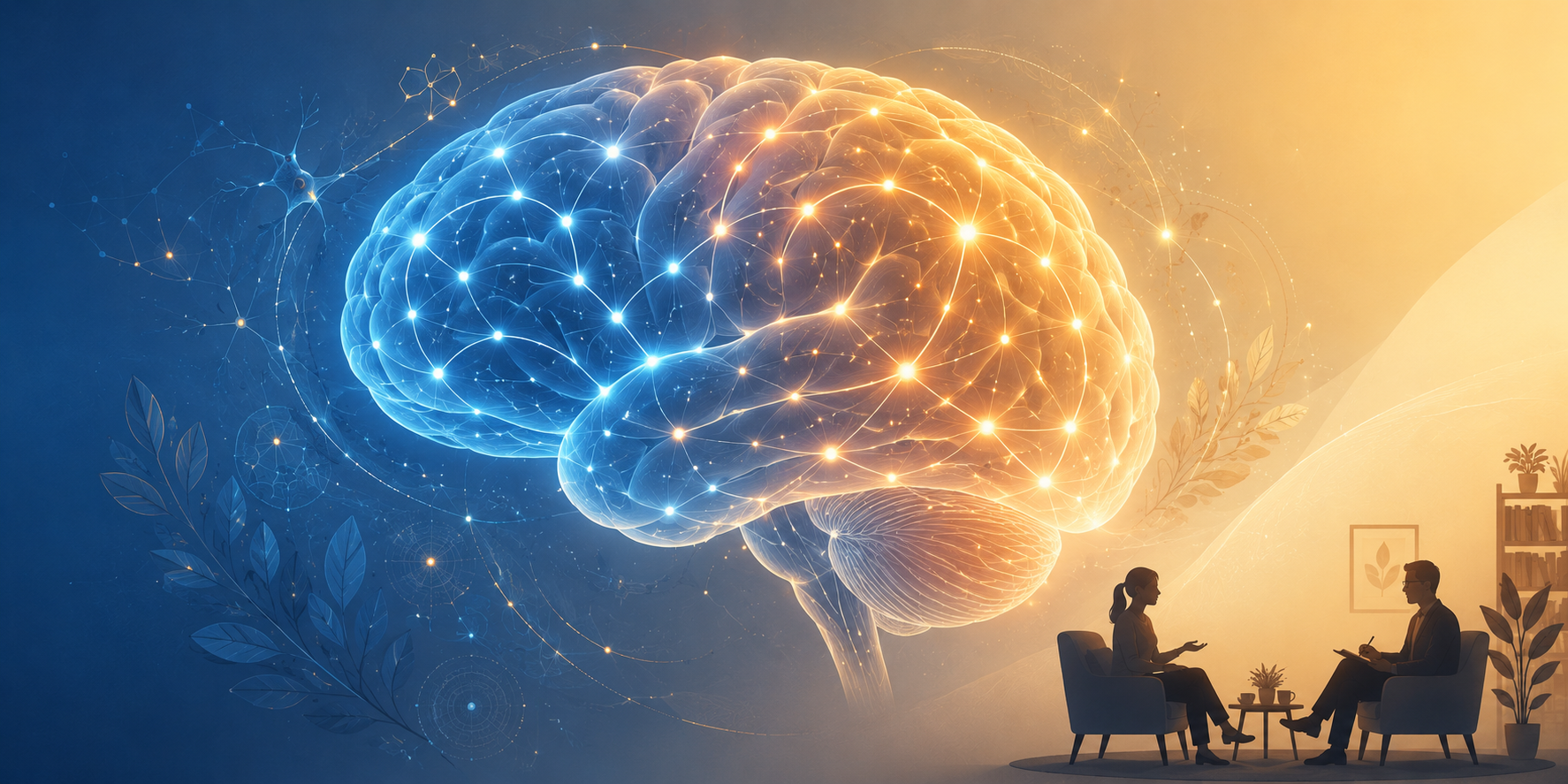
"Does therapy actually work?" is one of the most common — and most reasonable — questions people ask before booking their first session. Talking to someone once a week can sound simple, even underwhelming, compared to the size of what people are often struggling with. But the research tells a different story. This article looks at what decades of studies and modern neuroscience actually say about therapy effectiveness.
Evidence From Research
Therapy is one of the most extensively studied treatments in mental healthcare. Large-scale analyses pooling data across hundreds of individual studies have consistently found that psychotherapy produces meaningful improvements in day-to-day functioning and quality of life for people with depression. More broadly, research synthesising results across a wide range of conditions and regions has found that psychological treatments show small to moderate benefits for conditions like psychosis, suicidal ideation, and prolonged grief, while showing large benefits for depression, panic, and anxiety disorders. Importantly, this body of evidence spans a large number of studies and participants worldwide, not just isolated trials — which strengthens confidence in the findings.
Brain Changes
One of the most compelling developments in recent decades is neuroscience's ability to actually observe therapy's effects on the brain. Neuroimaging research shows that psychotherapy promotes neuroplasticity by changing brain circuits involved in memory, emotion regulation, and self-awareness, with measurable effects on regions such as the prefrontal cortex, hippocampus, and amygdala.
These aren't small or symbolic findings — they indicate that therapy is a physically active process that changes brain connections, not merely a conversation that makes someone "feel a bit better" temporarily. Specific findings include reduced activity in the right caudate nucleus following CBT for OCD, and decreased activity in limbic and paralimbic brain areas following CBT for phobias. Interestingly, some of these brain changes are strikingly similar to those seen after treatment with certain antidepressant medications — suggesting therapy and medication can work through overlapping biological pathways, even though one involves no medication at all.
Emotional Regulation
Many of the brain changes associated with therapy centre on the prefrontal cortex — an area involved in what researchers call "controlled emotion regulation." Changes in this region likely reflect increased recruitment of control processes involved in managing emotional responses, essentially strengthening the brain's ability to notice, interpret, and manage difficult emotions rather than being overwhelmed by them. Over time, this is often experienced as feeling less reactive and more in control during stressful moments.
Relationship Improvement
While much research focuses on symptom reduction, therapy also has ripple effects on relationships. As people develop better emotional regulation and self-awareness, common downstream benefits include reduced conflict, improved communication, and a greater capacity for empathy — both toward others and themselves. This is one reason therapy is often recommended not just for individual struggles, but during relationship transitions, family stress, or after a breakup.
Work Performance
Struggles with mental health rarely stay contained to one part of life. Anxiety, depression, and chronic stress commonly affect concentration, decision-making, and energy at work. As therapy helps address the underlying emotional and cognitive patterns, many people report improved focus, reduced burnout, and a better ability to manage workplace pressure — even though work itself was never the direct subject of a session.
Anxiety
Anxiety disorders are among the most well-researched applications of therapy. For social anxiety specifically, large reviews combining data from dozens of clinical trials have found that psychotherapy produces a large reduction in symptoms, with benefits holding up consistently across different study conditions. Broader analyses across anxiety disorders more generally have found similarly strong effects, reinforcing that anxiety is one of the conditions therapy addresses most effectively.
Depression
Depression has arguably the deepest body of research behind it. Comparisons across different therapeutic approaches have found that psychotherapy produces a moderate reduction in depressive symptoms compared to standard treatment, with approaches like cognitive behavioural therapy and behavioural activation therapy among the most consistently effective. Even in cases of treatment-resistant depression, where standard approaches haven't fully worked, structured psychotherapy continues to show meaningful benefit.
Trauma
Trauma-focused therapy has also been well studied outside high-income Western settings, which matters for a country as diverse as India. Research shows no indication that psychotherapy is less effective in low- and middle-income countries or non-Western cultures — a reassuring finding for anyone who's worried that "therapy is a Western concept" that won't translate to their own context and lived experience.
Long-Term Outcomes
Therapy's benefits often extend beyond the treatment period itself. Because approaches like CBT focus on building durable skills — not just managing symptoms in the moment — many people continue to use what they've learned long after sessions end. Neuroimaging research examining longer-term treatment has similarly found that extended psychotherapy is associated with measurable changes in brain regions involved in emotional processing, suggesting the shifts aren't just temporary coping, but reflect a genuinely different way the brain is functioning.
Common Myths
With all this evidence in mind, it's worth addressing a few persistent myths:
- "Therapy just means someone listens to you complain." In reality, structured therapy involves specific techniques shown to produce measurable psychological and even neurological change.
- "Only medication produces 'real' biological change." As neuroimaging research shows, therapy produces its own measurable brain changes — sometimes overlapping with those seen with medication.
- "Therapy doesn't work as well outside the West." Global research directly contradicts this, showing comparable effectiveness across diverse cultural contexts, including India.
- "If it hasn't worked after one or two sessions, it won't work." Most research is based on a defined course of multiple sessions — meaningful change typically builds over time, not instantly.
The science is clear: therapy isn't just a comforting conversation — it's a well-researched, biologically grounded intervention with real, measurable effects. If you've been on the fence about whether therapy works, the evidence suggests it's worth finding out for yourself. TherapyHelps.in can match you with a licensed psychologist suited to your specific concerns, so you can experience these benefits firsthand.
References:
- Furukawa et al., "Effectiveness of Psychotherapy: Synthesis of a Meta-Analytic Research Domain Across World Regions and 12 Mental Health Problems"
- "The efficacy of psychotherapy, pharmacotherapy and their combination on functioning and quality of life in depression: a meta-analysis" (PMC)
- "Effectiveness of Psychological Therapy for Treatment-Resistant Depression in Adults: A Systematic Review and Meta-Analysis" (PMC)
- "The efficacy of psychotherapy for social anxiety disorder, a systematic review and meta-analysis" (ScienceDirect)
- "How psychotherapy changes the brain – the contribution of functional neuroimaging" (Molecular Psychiatry / PubMed)
- "Neural Correlates of Psychotherapy in Anxiety and Depression: A Meta-Analysis" (PMC)
- "Changes in Prefrontal-Limbic Function in Major Depression after 15 Months of Long-Term Psychotherapy" (PMC)